

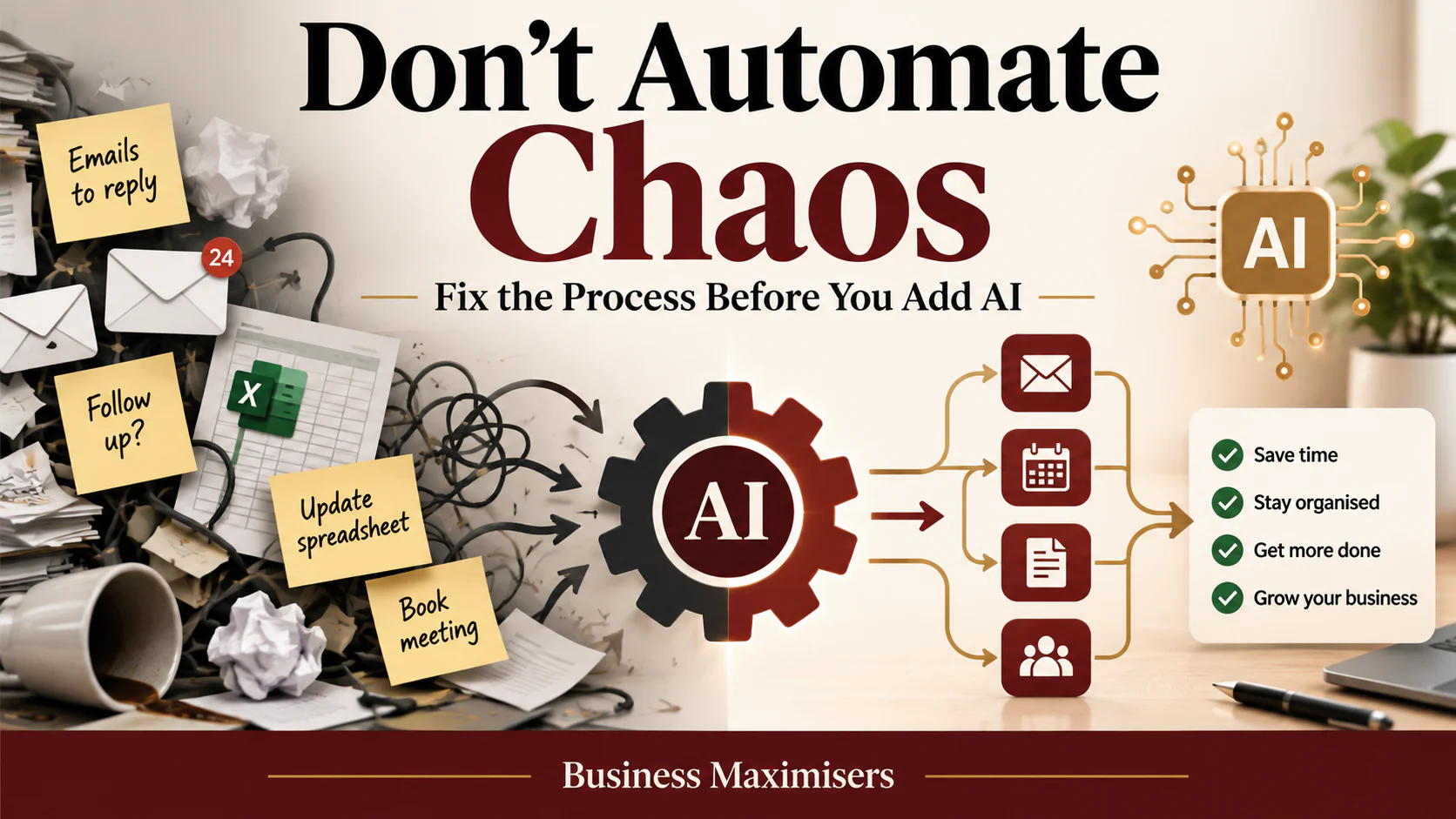
Fix the Process Before You Add AI
AI automation sounds fantastic.
Connect a few apps, let AI handle the repetitive work, automate your follow-up, update records in the background and suddenly you have hours of your week back.
That is the promise, anyway.
But there is one mistake that can turn automation into a bigger headache than the work it was supposed to replace:
Automating a process that was already a mess.
If a business process is confusing, repetitive or badly organised, automation does not magically fix it. It simply makes the same bad process happen faster and more consistently.
Automation Magnifies What You Already Have
Imagine you onboard a new customer manually.
They make an enquiry. You reply by email. Later you remember to send them a form. Their details get copied into a spreadsheet. Then you add some of the same information into another system. You create a reminder to follow up. A few days later, you realise you forgot to send something else.
Now imagine automating that entire process exactly as it is.
You may save some time, but you have also built a machine that repeats every unnecessary step perfectly.
Before worrying about AI tools, integrations or clever workflows, it usually makes more sense to fix the process itself.
Start With What Actually Happens
Choose one task or process that regularly takes up your time.
It might be:
- Responding to new enquiries
- Following up with leads
- Booking appointments
- Onboarding new customers
- Updating spreadsheets or a CRM
- Preparing regular reports
- Sending reminders or confirmations
Then write down what actually happens from beginning to end.
Not what you think should happen.
Not the perfect version of the process.
Write down what really happens today.
For example:
Customer submits a form → you receive an email → you copy their details into a spreadsheet → you send a reply → you add them somewhere else → you create a reminder → you follow up later.
Once the process is written down, the waste becomes much easier to see.
Look for the Repetitive Bits
You may discover that you are entering the same information in two different places.
You might be asking customers for information you already have.
Perhaps three separate emails could be replaced by one good email.
Maybe you are manually sending appointment reminders that your calendar software could already handle.
Or perhaps you create the same weekly report by copying figures from the same places every Friday.
These are the parts worth looking at first.
Some of the most common automation opportunities in a small business are data entry, follow-up, scheduling, reporting and customer onboarding.
They tend to work well because they happen repeatedly and usually follow predictable rules.
Not Everything Should Be Automated
One of the easiest traps to fall into is assuming that because something can be automated, it should be automated.
That is not always true.
A task that happens once every six months and takes ten minutes probably does not deserve an elaborate automation system.
A job that requires judgement, empathy or an important business decision may still need a human involved.
The best starting point is usually work that is:
repetitive, frequent, predictable and time-consuming.
If you find yourself thinking, “I do this same bloody thing every day,” there is a good chance it is worth investigating.
Where AI Automation Fits Into the Picture
Traditional automation and AI are related, but they are not quite the same thing.
Automation is good at moving information and triggering actions.
For example, when someone fills in a form, an automation could add their details to your contact system, send a notification and create a follow-up task.
AI becomes useful when the information needs some interpretation.
It can help summarise an enquiry, classify a message, draft a personalised reply, organise meeting notes or recommend what should happen next.
A useful way to think about it is:
AI can act like the brain. Automation acts like the hands.
For example:
A customer submits an enquiry. The information is passed to AI. AI summarises what the customer needs and drafts a response. The enquiry is added to your CRM. A follow-up reminder is created automatically.
That is much more useful than simply moving information from one place to another.
But the underlying process still needs to make sense first.
Try This Before You Automate Anything
Take one process you repeat every week and ask yourself:
- Where does the process start?
- What happens next?
- Where is information copied manually?
- Where do delays usually occur?
- Which steps are duplicated?
- Which steps require a real human decision?
- Which steps happen almost exactly the same way every time?
- Could any steps simply be removed?
You may discover that the biggest improvement is not an expensive automation platform or a complicated AI system.
Sometimes deleting three pointless steps saves more time than automating all three.
Use AI to Help Clean Up the Process
You can even use AI before you build the automation.
Copy the prompt below into ChatGPT or your preferred AI assistant and describe one of your existing business processes.
AI Prompt:
Review the business process below and help me simplify it before I automate it.
Identify unnecessary steps, duplicated work, bottlenecks, delays and places where information is being entered more than once.
Then suggest a simpler version of the process and tell me which remaining steps are good candidates for AI, no-code automation, or both.
Current process:
[Describe the process step by step]
Simplify First. Automate Second.
AI and automation can save a small business an enormous amount of repetitive work when they are applied in the right places.
But adding technology to a broken process rarely fixes the problem.
Before building your next automation, spend a little time looking at how the work is being done now.
Remove what is unnecessary. Simplify what is confusing. Decide where a human genuinely adds value.
Then automate what remains.
A simple process with a little automation will usually beat a complicated process with a lot of automation.


